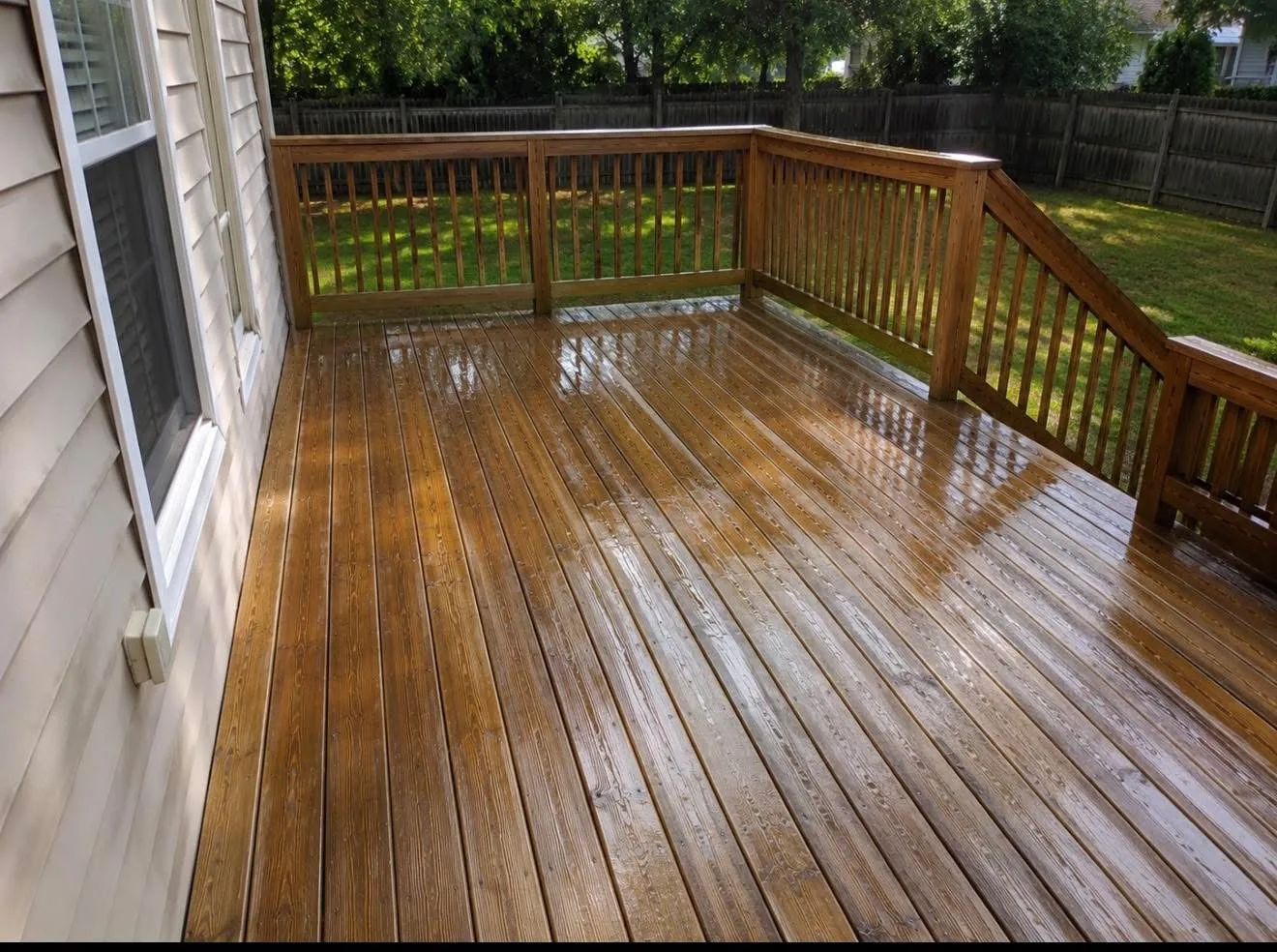
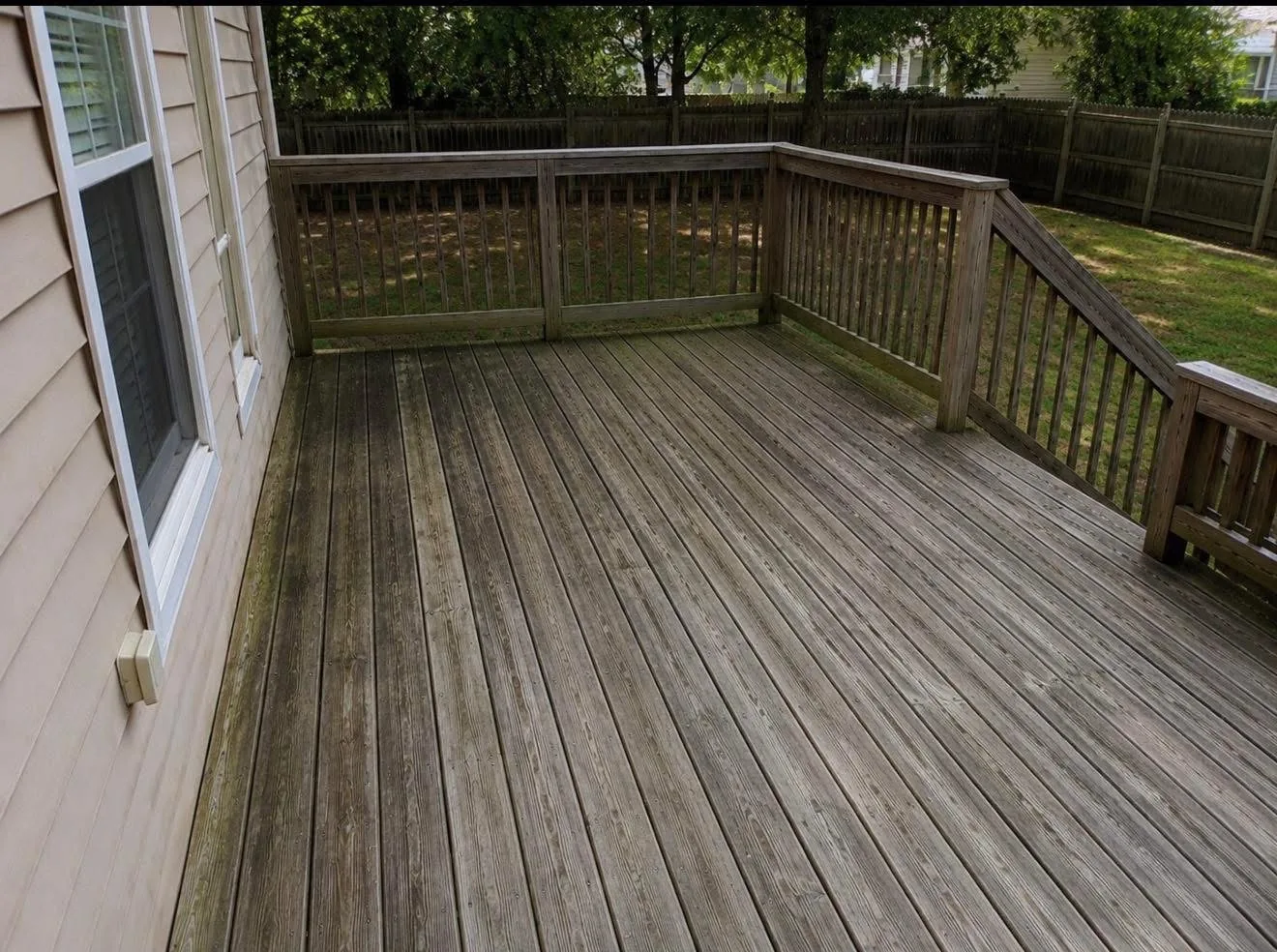
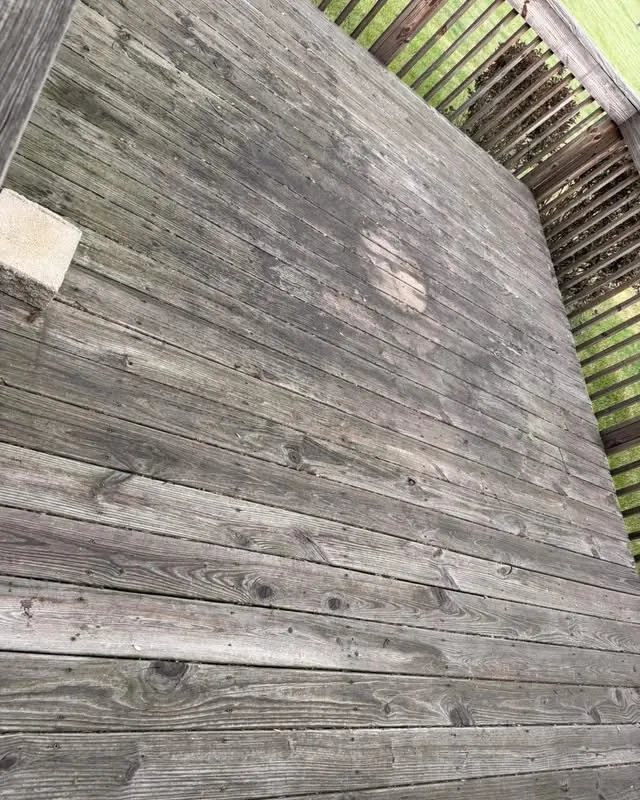
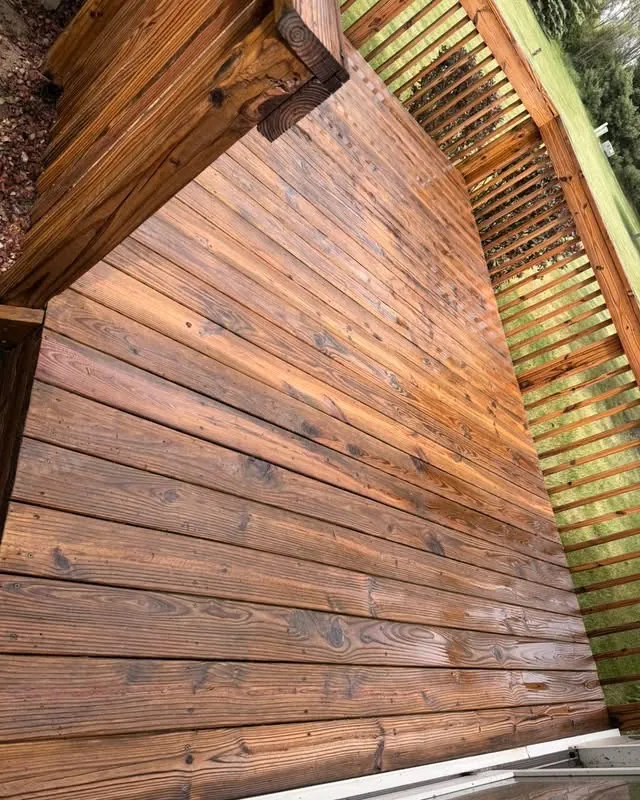
A deck is one of the easiest exterior surfaces to damage while trying to clean it. Every spring around Sterling and Rock Falls, well-meaning homeowners fire up a rented pressure washer, dial it to full power, and end up with fuzzy, striped, or gouged boards that look worse than the grime they started with.
The good news is that these mistakes are avoidable. This guide walks through what actually goes wrong, why pressure alone is the wrong tool, and how the right process changes from one deck material to the next — so you can get a cleaner deck without ruining the wood.
Want a professional to handle it? Call Rock River Home & RV any day of the week at 779-251-9133 for a free, no-pressure estimate.
The Biggest Mistake: Too Much Pressure
Wood is tougher than it looks, but its surface fibers are vulnerable to a concentrated stream of water. When the pressure is too high or the tip sits too close, a few distinct problems can show up:
- Raised grain and fuzzing — torn surface fibers that feel rough and can catch bare feet
- Splintering — softer boards fraying along the grain
- Gouging — the stream carving into the wood itself
- Striping — light and dark bands left by uneven wand speed
- "Tiger lines" — sharp marks from holding the tip too close that can telegraph through a later stain
Not every one of these is permanent or catastrophic — light fuzzing is very different from deep gouging — but all of them are easier to avoid than to correct. Prevention, not repair, is the real goal.
Why Pressure Alone Is the Wrong Tool
Pressure is only one lever, and a good deck clean treats it as the last one. The result depends on a whole combination of variables:
- The wood species and the deck's age and condition
- Any existing coating (stain, sealer, paint) and the manufacturer's guidance
- The cleaning solution and how long it's allowed to dwell
- Water flow, nozzle selection, and working distance
- Technique — steady, overlapping passes rather than digging in one spot
- Weather and how the boards will dry
Let the cleaning solution do the heavy lifting and the pressure can stay low. For the bigger-picture comparison of when to use higher pressure versus a gentler soft-wash approach on different surfaces, see our guide on pressure washing vs. soft washing.
There Is No Universal "Safe PSI"
People always want a magic number, but there isn't one. A safe setting for a weathered pressure-treated deck is not the same as for aged cedar, a coated hardwood, or a composite board. The right pressure depends on the material, its condition, the coating, the nozzle, the distance, and the solution doing the work.
That's why professionals test an inconspicuous area first and tune the approach to the deck in front of them, rather than committing the whole surface to a single number.
Know Your Material: Different Decks, Different Care
Pressure-Treated Pine
The most common deck material in our area. It's durable but soft, and it can raise grain and fuzz easily under too much pressure. Lower pressure with the right cleaner, plus attention to how the boards dry, usually gives the best result.
Cedar
Prized for its look, but soft and easy to mar. Cedar rewards a gentle approach and careful technique so the surface isn't torn while lifting gray weathering and organic growth.
Hardwood
Denser tropical hardwoods can tolerate a bit more, but "more" is relative — they still get tested first, and technique still guides the settings so the grain isn't scarred.
Painted or Stained Wood
An existing coating changes everything. Aggressive cleaning can strip or blotch paint and stain, so a coated deck is evaluated for how the finish is holding up before choosing an approach. Cleaning a coated surface is not the same as preparing bare wood.
Composite Decking
Composite is not treated like bare wood. It should be cleaned according to its manufacturer's instructions, using a method suited to the manufactured surface. Mismatched chemistry or too much pressure can leave marks or streaks that are highly visible in sunlight, so composite gets its own careful, manufacturer-appropriate process.
How Pros Sequence the Work
A clean, even deck comes from order and control, not force. A typical professional sequence looks like this:
- Prep — protect plants, cover nearby surfaces, and plan runoff
- Clean — apply a suitable solution and let it dwell so it does the work
- Rinse — controlled, top-down rinsing that clears soils without driving water into seams
- Brighten (when appropriate) — a wood brightener may help normalize appearance or pH after certain cleaning steps
That brightening step is not automatic. A wood brightener may help even out tone or restore pH after certain processes, but it isn't necessary for every deck, cleaner, coating, or manufacturer system — it's used when it actually helps the specific surface and products in play. And while good prep and cleaning help a later stain go on more evenly, no process can guarantee stain adhesion or prevent future peeling.
What Deck Cleaning Is — and Isn't
It's worth being clear about the boundary of cleaning, because it's easy to expect too much from it:
- Cleaning is separate from sanding, staining, sealing, and board replacement
- Cleaning is separate from fastener repair and structural repair
- Cleaning does not correct rot, loose fasteners, or warped boards
- Cleaning does not fix failed coatings, unstable railings, or structural defects
A wash can make a tired deck look dramatically better and prepare it for a future finish, but the parts that keep a deck safe and sound — the framing, fasteners, and railings — need proper inspection and repair, not just cleaning.
If a Deck Is Already Damaged
If your boards are already fuzzy, striped, or gouged from a past cleaning, the right correction depends on the type and severity of the damage. Light surface fuzzing may resolve differently than deep marks, and not every damaged deck needs sanding. A good approach is to evaluate the surface honestly and match the correction to what's actually there — rather than assuming the worst-case fix.
Signs Your Deck Needs a Professional Cleaning
- Green film or dark patches that return days after rain
- Gray, dull boards where water no longer beads up
- Black drip lines beneath railings or where planters sit
- Slippery steps or shaded corners that feel slick underfoot
- Patchy color that hints at striping from a past cleaning
- A general dinginess before you plan to stain or seal
Several of these together usually mean it's time for a measured, material-appropriate cleaning.
Why Local Weather Makes Deck Timing Matter
Our Midwest seasons are hard on decks. Spring brings pollen and cottonwood that stick to damp boards, humid summers around Dixon, Oregon, and Morrison feed algae in shaded spots, and repeated freeze-thaw swings can work at hairline cracks and weathered surfaces over time. Decks near mature trees or on the shaded north side stay damp longest and tend to grow the most organic film.
Whether your deck is in Sterling, Rock Falls, Mount Carroll, or across the region toward Rockford, Belvidere, Garden Prairie, Moline, Davenport, or Clinton, we tailor the approach to the material, its condition, and the weather. You can see where we work on our service areas page, and if you're caring for a fence too, our fence-cleaning guide covers those materials.
Frequently Asked Questions
Will pressure washing ruin my deck?
Not necessarily — but the wrong pressure or technique can. Wood decks are more forgiving with the right cleaning solution and controlled technique than with brute force. The safest results come from matching the method to the material and its condition rather than reaching for maximum pressure.
Is there a safe PSI for decks?
There is no single safe PSI for every deck. The right amount of pressure depends on the wood species, the deck's age and condition, any existing coating, the nozzle and distance, water flow, and the cleaning solution doing the work. A pro tests an inconspicuous area and adjusts rather than applying one number to every board.
Do you always have to sand a deck after cleaning?
No. Sanding is not automatically required. Whether any correction is needed — and what kind — depends on the type and severity of the issue. Light surface fuzzing behaves very differently from deep gouging, and many decks that are cleaned correctly need no sanding at all.
Do I need a wood brightener?
Not always. A wood brightener may help normalize appearance or pH after certain cleaning processes, but it is not automatically necessary for every deck, cleaner, coating, or manufacturer system. Whether it helps depends on the wood, the products used, and the result you're after.
Can you clean a composite deck?
Yes, but composite is not treated like bare wood. Composite decking should be cleaned according to its manufacturer's instructions, using a method suited to the manufactured surface. Aggressive technique can leave marks, so composite gets its own careful approach.
Will cleaning restore my deck's original color?
Cleaning can noticeably improve tone and lift gray weathering and organic staining, but it does not guarantee a return to the original color. How much a finish improves depends on the wood's age, condition, and how it has weathered.
Does deck cleaning include staining or repairs?
No. Cleaning is a separate step from sanding, staining, sealing, board replacement, and structural or fastener repairs. Cleaning also does not correct rot, loose fasteners, warped boards, failed coatings, or unstable railings — those need proper repair, not a wash.
Get a Safer, Better-Looking Deck
If your boards are slick, gray, or showing stripes from a past cleaning, let us take a look and recommend a material-appropriate approach — no guesswork, no over-pressuring. Review what's included on our deck cleaning service page, or browse more homeowner guides in our detailing articles.
Call 779-251-9133 for professional, material-appropriate deck cleaning across Sterling and Northern Illinois.