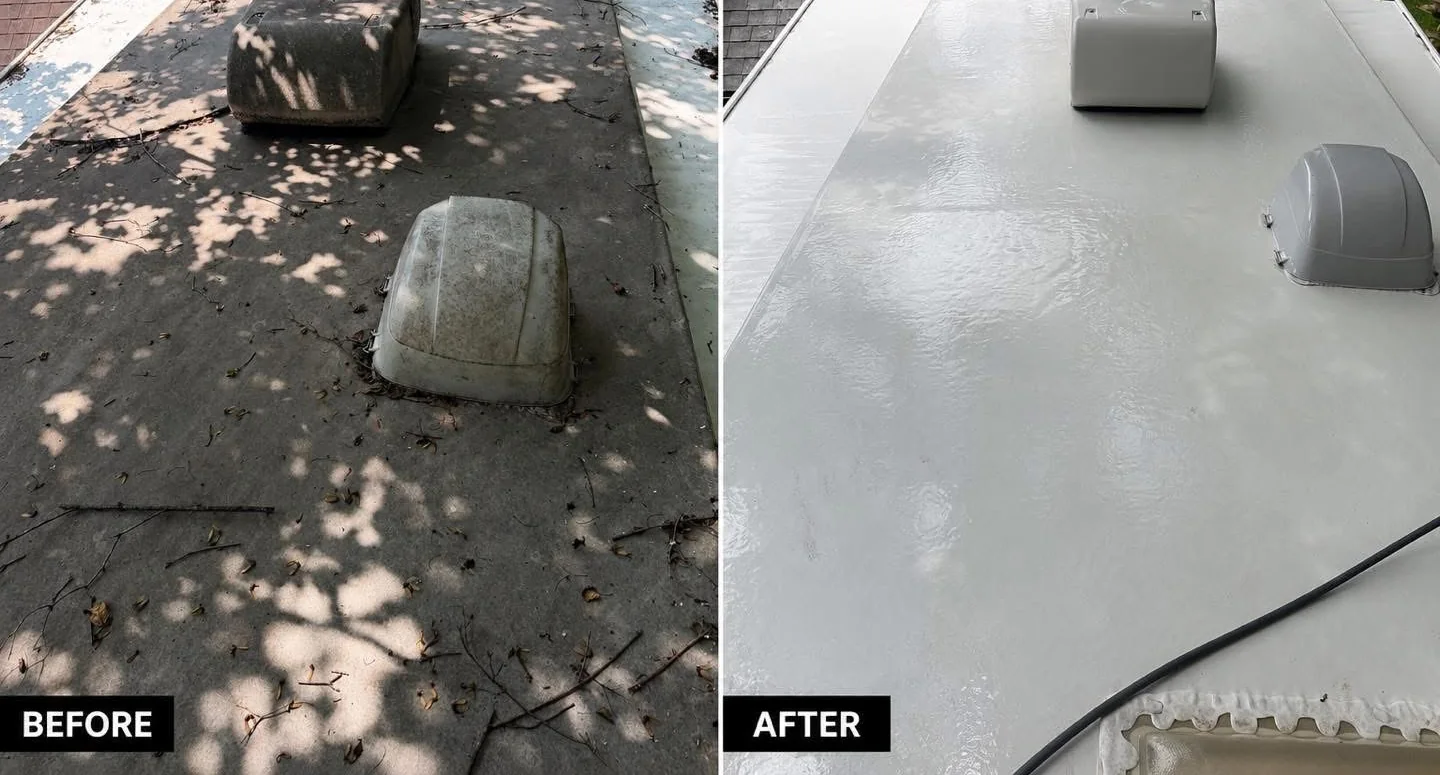
The roof is the hardest-working and least-seen surface on your RV. It takes the full brunt of sun, rain, tree debris, and road exposure, yet most owners rarely get a good look at it — and that's exactly how a dirty, streaky roof sneaks up on you. Across Sterling, Rock Falls, and the wider region, roof buildup is one of the most common things we help RV owners with, and it's also one of the most misunderstood.
This guide is here to help you care for your RV roof sensibly and safely. We'll cover why roofs get so dirty, why the roof material has to be identified before anyone cleans it, and — just as importantly — where cleaning ends and where an RV repair professional needs to take over. One thing up front: we don't recommend turning roof care into a DIY climb, and not every RV roof is even designed to be walked on.
If your roof is overdue for attention, you can reach Rock River Home & RV any day of the week at 779-251-9133 to request a free estimate.
Why RV Roofs Collect So Much
Your roof is a large, mostly flat, mostly horizontal surface that sits still for long stretches — a perfect catch-all for whatever the environment drops on it. Over a season, an RV roof can accumulate:
- Dirt, dust, and fine environmental film that settles out of the air
- Pollen, especially heavy in spring around wooded and rural areas
- Tree debris, leaves, and needles that trap moisture against the surface
- Tree sap and the sticky honeydew that comes with it
- Bird droppings, which are acidic and unsightly
- Algae- or mildew-like organic staining that takes hold where the surface stays damp
Because the roof holds moisture longer than the sloped sidewalls, organic staining tends to appear there first. Along the Rock River and near the Mississippi, humid summers keep roofs damp, and rigs parked under trees around Oregon, Mount Carroll, and Morrison collect noticeably more sap and organic debris than those kept in the open.
How a Dirty Roof Feeds Black Streaks
Ever notice the dark streaks running down the sides of an RV, worst on the side that catches the most rain? A lot of that starts on the roof. Rainwater lands on all that accumulated dirt and film, picks it up, and carries it down the sidewalls, where it dries in place as streaking.
Keeping the roof clean is one part of managing that, but black streaks are their own topic with their own nuances — we cover them in detail in our guide on protecting an RV from bugs, sap, road film, and black streaks. For roof care specifically, the key point is simply that what collects up top doesn't stay up top.
Identify the Roof Material Before You Clean Anything
This is the single most important idea in RV roof care: the roof material dictates how it should be cleaned. Using the wrong method or product on the wrong material is one of the fastest ways to cause damage, so identifying what you have comes first. RV roofs generally fall into a few categories, each with its own characteristics and — critically — its own manufacturer guidance.
EPDM Rubber
A common rubber membrane roof. It has its own care considerations, and some products and techniques that are fine elsewhere are not appropriate for it. The manufacturer's instructions for your specific membrane are the authority.
TPO
Another widely used single-ply membrane. It looks similar to EPDM to an untrained eye but is a different material with different care guidance, which is part of why identifying the roof correctly matters.
PVC
A membrane roofing option with its own properties and recommended care. As with the others, what's approved for a PVC roof should come from the manufacturer, not a one-size rule.
Fiberglass
A harder, molded roof surface found on some rigs. It behaves more like the fiberglass on the rest of the coach, but it still has specific care considerations and can be affected by the wrong approach.
Aluminum
Found on some campers and older rigs. Aluminum has its own cleaning considerations and, again, its own manufacturer guidance worth following.
Coated Roof Systems
Some roofs have applied coatings, which change what is and isn't appropriate to use on them. Coatings especially call for following the coating maker's directions so you don't compromise the very layer meant to protect the roof.
We're intentionally keeping these descriptions general, because the right products and methods vary by material, by product, and by the roof's condition — and the manufacturer's instructions for your particular roof always take precedence over any general advice.
Why the Wrong Approach Can Cause Damage
It's tempting to think a roof is tough enough to take whatever gets it clean fastest. That's not the case. Depending on the material, the wrong approach can do real harm:
- Excessive pressure can damage certain roof materials and force water where it doesn't belong
- A close, high-pressure spray can disturb the sealant around seams, vents, and other openings
- Aggressive scrubbing can mar or wear some surfaces and coatings
- Harsh or incompatible chemicals can degrade certain membranes, coatings, or finishes
- Improper tools can scratch, gouge, or abrade the surface
This is why pressure washing is not automatically the right answer for an RV roof — on some materials it's exactly the wrong choice. The safe path is to match a material-appropriate method to the roof in front of you, guided by the manufacturer's recommendations, rather than reaching for maximum force.
Cleaning, Observations, Inspection, and Repair Are Different Things
A lot of confusion — and a lot of disappointment — comes from blurring these together, so let's be clear about what each one is:
- Roof cleaning — removing dirt, film, organic staining, and debris from the surface using a material-appropriate method
- Basic visual observations — while we clean, we may notice and point out obvious visible concerns so you're aware of them
- Formal inspection — a thorough, technical evaluation of the roof's condition, which is a separate professional service
- Maintenance — ongoing upkeep such as recommended care and manufacturer-directed attention
- Resealing — renewing sealant around seams and penetrations, which is repair work
- Leak diagnosis — testing and pinpointing water intrusion, a specialized diagnostic service
- Repair — fixing sealant, components, seams, decking, or structure
Here's exactly where we fit: Rock River Home & RV provides RV roof cleaning and material-appropriate exterior cleaning. While cleaning, we may notice and point out visible concerns, but cleaning is not a formal inspection, leak diagnosis, or repair service. When something looks like it needs repair, we'll tell you so you can bring in the right professional.
What Owners Can Watch For — Safely, From the Ground
You don't need to climb up to stay aware of your roof's general condition, and we'd rather you didn't. From the ground, or in conversation with a professional who is handling the roof, these are the areas that tend to matter most:
- Seams, where sections of roof material meet
- Vents and their surrounding sealant
- Skylights and their edges
- Roof-mounted air-conditioning units
- Antennas and other mounted accessories
- The roof-access ladder and its mounting points
- Roof edges where the top meets the sidewalls
- Any penetration where something passes through the roof
Think of this as general awareness, not a technical assessment. If anything around those areas looks off to you — or if we point something out while cleaning — the next step is a qualified professional, not a closer look from a ladder. Not every RV roof is built to be walked on, and working at height simply isn't worth the risk for a homeowner.
What Cleaning Does Not Do
This is important enough to state plainly. Cleaning improves the roof's appearance and removes buildup — but it does not repair problems, and it should never be mistaken for repair. Cleaning does not fix:
- Cracked or failed sealant
- Loose or shifting roof components
- Punctures in the roof material
- Failed or separating seams
- Active or suspected leaks
- Soft or deteriorating decking
- Any structural problem
Cleaning also does not prevent leaks or water damage, and it doesn't reseal or renew the roof. If you suspect a leak, a soft spot, damaged sealant, or any structural concern, that calls for an appropriate RV repair professional — an RV repair technician, a dealership, a qualified roof specialist, or the roof or coach manufacturer. Those are the right people to diagnose and fix what cleaning can't.
How Our Climate and Your Storage Shape Roof Care
Northern Illinois and Eastern Iowa give an RV roof plenty to deal with, and where you keep the rig matters as much as the calendar:
- Outdoor storage exposes the roof to constant sun, rain, and debris year-round
- Tree cover around Oregon, Mount Carroll, Morrison, and Garden Prairie adds sap, pollen, and organic staining
- Strong sun and UV are hard on membranes and coatings over time
- Humid summers along the Rock River and near the Mississippi keep roofs damp and encourage organic staining
- Seasonal travel toward Rockford, Belvidere, and the Quad Cities of Moline, Davenport, and Clinton adds road film and airborne grime
- Midwest freeze-thaw winters and long storage stretches let debris and moisture sit on the surface
None of this means a dirty roof was neglected — it's simply what our climate does to a surface that faces the sky. Understanding your storage and travel pattern is the first step in deciding how often the roof realistically needs attention.
There's No Universal Cleaning Interval
People often want a set schedule, but an honest answer resists a fixed number. How often an RV roof should be cleaned depends on several things working together:
- The roof material and its manufacturer guidance
- How and where the RV is stored — indoors, covered, or outdoors
- Tree and sun exposure at the storage spot
- How much and how far you travel
- The roof's current condition
- How it has been cared for previously
A garage-kept coach driven a few weekends a year is a very different case than a frequently traveled rig stored outside under trees. If you'd like help thinking through a sensible rhythm for the whole exterior, our guide on how often to schedule an RV wash and wax walks through the factors, and the same logic applies to the roof.
What to Realistically Expect From Professional Cleaning
Here's the grounded version. Professional, material-appropriate roof cleaning removes dirt, film, debris, and much of the organic staining that builds up on the surface, and it helps the whole rig look cared for. What it won't do is guarantee that every stain, sap spot, or bit of organic growth disappears completely, and it won't prevent buildup or streaks from returning — surfaces exposed to the outdoors will always collect more over time.
We also won't promise that cleaning protects against leaks or extends the roof's life by some specific amount, because those claims wouldn't be honest. What we will do is clean the roof appropriately for its material, point out anything obvious we notice while we're up there working, and be straight with you about what's a cleaning matter and what belongs with a repair professional. If a chalky, faded finish is your bigger concern than roof grime, our guide on RV oxidation removal covers that side of exterior care.
Frequently Asked Questions
Can you pressure wash an RV roof?
Not necessarily — and not on every roof. Pressure washing is not automatically appropriate for RV roofs, and too much pressure can damage certain materials and, more importantly, disturb the sealant around seams, vents, and other openings. The right approach depends on the roof material and its condition, and on the manufacturer's guidance for that roof. We evaluate the surface and choose a material-appropriate method rather than assuming pressure is the answer.
Does my RV roof type change how it should be cleaned?
Yes, quite a bit. EPDM rubber, TPO, PVC, fiberglass, aluminum, and coated roof systems behave differently, and each has its own manufacturer guidance about what is and isn't appropriate. That's why identifying the roof material comes before any cleaning — using the wrong method or product on the wrong material is how roofs get damaged. When in doubt, the manufacturer's instructions for your specific roof are the authority.
Do black streaks mean my RV roof is leaking?
No — black streaks by themselves do not mean the roof is leaking. Those streaks are usually runoff: rain picks up dirt and roof film and carries it down the sidewalls. It's a cleaning and appearance issue far more often than a leak. That said, if you ever suspect a leak, a soft spot, or damaged sealant, that's a question for an appropriate RV repair professional — not something cleaning addresses. For more on the streaks themselves, see our black-streaks guide.
Is RV roof cleaning the same as a roof inspection?
No. Cleaning is cleaning. While we clean, we may notice and point out visible concerns to you, but that is not a formal inspection, leak diagnosis, or repair service. A formal inspection, leak testing, resealing, and repairs are the domain of an RV repair technician, dealership, qualified roof specialist, or the manufacturer. We keep those roles clearly separate so you know exactly what you're getting.
Should I clean my RV roof myself?
We'd gently steer you away from turning it into a DIY climb. Not every RV roof is designed to be walked on, and working at height carries real risk that isn't worth it for a cleaning. Beyond the safety side, using the wrong method or product for your roof material can cause damage. If your roof needs attention, it's usually safer and simpler to have it handled by someone equipped for it — reach out and we'll take a look.
How often should an RV roof be cleaned?
There's no universal interval. The right rhythm depends on the roof material and its manufacturer guidance, how and where the RV is stored, tree and sun exposure, how much you travel, the roof's current condition, and how it's been maintained. A rig kept outdoors under trees will generally need attention sooner than one stored inside. Rather than a fixed calendar, we look at your specific situation and suggest a sensible cadence.
Let's Take a Look at Your RV Roof
If your roof is streaked, stained, or overdue for a clean, the safest next step is to let someone handle it who's equipped for the job and knows to match the method to the material. We'll clean it appropriately, flag anything obvious we notice, and point you to the right professional if a repair concern comes up. You can review everything we handle on our exterior RV detailing page, see where we travel on our service areas page, or browse more guides in our detailing articles.
Call 779-251-9133 to request a free estimate for RV roof cleaning across Northern Illinois & Eastern Iowa.